
Menu
Flat and Level Concrete Slabs Built for Somerville’s Sloped Lots
Concrete Slab Somerville
The city of Somerville is famous for its many hills – such as the very steep Winter Hill, or the less steep but still hilly streets of Spring Hill. The beauty of these many hills is their view; however, they are also one of the greatest obstacles that exist for both construction and landscaping in the city. In creating an area of usable, outdoor space on a sloped yard, engineers must create a completely level concrete slab by excavating and then leveling the ground and installing retaining walls to prevent erosion. This process is much more complex than simply pouring cement, as it requires a great deal of planning and precise workmanship. By successfully bringing a slope under control, you will be able to add to your property’s usable square footage.
Leveling on a Slope Calls for Expertise
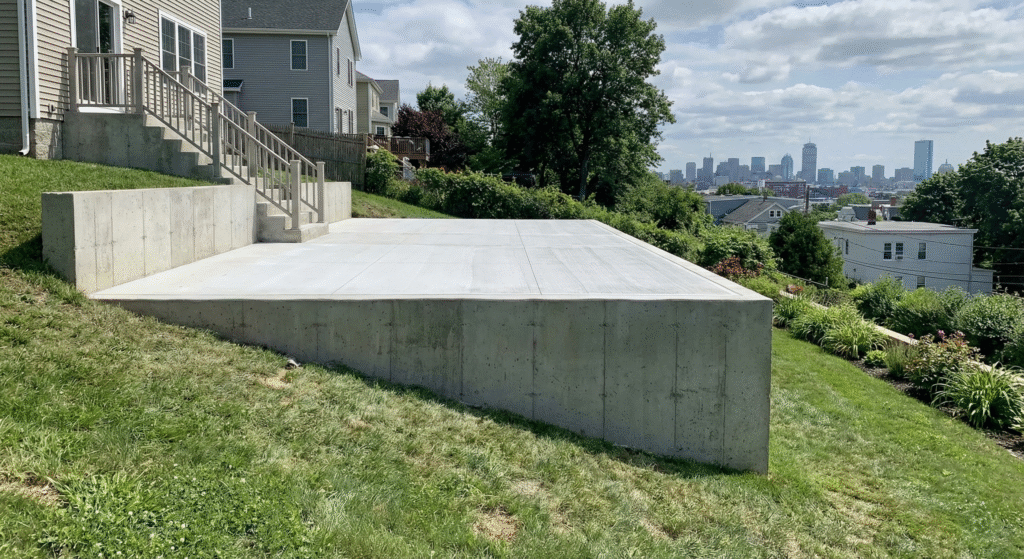
Leveling on a slope requires a broad knowledge of how gravity affects the earth and soil mechanics. Simply dumping materials onto a hill will cause them to slide and crack quickly. To create a flat surface, we must excavate (cut) the higher side of the slope and build up (fill) the lower side. This process is known as a “cut and fill.” This method provides balance but requires extensive compaction of the soil to provide a stable sub-base for the slab to sit on, ensuring the slab does not settle unevenly later.
Support for Retaining Walls and Stability
Retaining walls are essential to prevent earth erosion on the high side of the slope and to support the fill on the low side. These walls function as the borders of the new flat area and prevent the soil from collapsing. For ultimate stability, we combine the slab foundation with the retaining wall. Reinforced concrete walls are necessary to withstand the tremendous pressure applied by the weight of the soil, providing a solid boundary to contain the fill.
Proper Drainage for Slopes
Drainage planning is the most critical component of constructing a flat slab on a slope, as water moves rapidly down a hill. Disrupting that movement can lead to pooling or erosion. We install French drains and catch basins behind retaining walls to divert hydrostatic pressure downward. The slab itself must have a slight pitch to direct rainwater off the house. Managing this run-off is critical to protecting your new structure and adjacent properties.
Structural Reinforcement
A slab constructed on a slope experiences various forms of stress that differ from flat ground. The fill side is especially susceptible to settlement. To tie the entire slab together, we use a robust steel rebar grid. This ensures the concrete acts as a singular monolithic unit, bridging small imperfections in the soil beneath. Using high-strength concrete mixes further ensures the slab can withstand heavy loads.
Logistical Challenges on Steep Hills
Obtaining supplies for a backyard located on a steep slope presents a logistical challenge. Standard concrete trucks often cannot access these narrow, inclined areas. We commonly utilize concrete pumps to deliver the concrete mix from the street, through fences, or up steep drives. These pumps allow for accurate material deposition without damaging the surrounding landscape, managed by our staff experienced in difficult access points.
Terracing Your Yard for Multiple Levels
Instead of fighting the slope to create one large flat surface, terracing the yard with multiple smaller slabs can be a better design decision. This creates separate areas for activities (e.g., a dining area on the upper level and a fire pit lounge on the lower level). Steps link the different levels, allowing for smooth transitions. Multi-level systems often require less excavation than creating one large flat surface and offer a more natural look that complements the surrounding terrain.
Aesthetic Integration and Safety
A bare gray slab can look harsh on a hillside. We soften the visual impact of the slab and retaining walls using methods like textured stucco or stone veneer finishes. Incorporating plant beds into the design also helps visually hide the differences in elevation. When creating elevated flat surfaces, safety is paramount; building codes establish railing requirements for any drop-off greater than a specific height.
Municipal Permits, Regulations, and Foundations
Altering the topography of a lot triggers municipal involvement, focusing on adequate water runoff and structural integrity. We draft and submit detailed site plans showing the new grade relative to property lines to meet local regulations. Additionally, we create level foundations for outbuildings (sheds, studios, etc.), ensuring anchor bolts are correctly installed to secure the structure against wind, and guaranteeing doors and windows operate properly.
Partner with Us for Challenging Terrain
Don’t let a sloping yard deter you. Somerville Concrete Masters has the technical knowledge and skills necessary for the complicated earthwork and forming required for sloping properties. We transform challenging geography into a durable, compliant, and functional advantage for your home. We’re here to level the playing field for your next project.
LATEST POSTS

Somerville Homes: Replacing Brick Paths With Concrete Walkways
December 15, 2025
No Comments
Somerville Concrete Foundation Repair for Settlement Issues
December 13, 2025
No Comments