Somerville Concrete Masters - Frequently Asked Questions
If Your Question Is Not Answered Here Drop Us A Line
Does heavy vehicle traffic influence driveway design specifications and reinforcement requirements in Somerville?
Heavy vehicles, including recreational vehicles, commercial trucks, and specialty equipment, require thicker slab installations (5-6 inches), enhanced reinforcement with rebar, and thoroughly compacted base materials. Standard residential specifications may demonstrate cracking vulnerability under frequent heavy-load conditions. Communicate anticipated traffic patterns and load expectations to contractors during design consultations for proper specification development.
What expenditure range should homeowners anticipate for concrete driveway installations in Somerville?
Generally, a plain gray concrete driveway costs between $5 to $7 per square foot, while a decorative driveway can range from $8 to $18 per square foot. The cost of labor accounts for approximately half of your total concrete driveway project cost, or around $2 to $10 per square foot. For a 600 square feet project, you can expect to pay around $500 to $600 for concrete material. These estimates provide a foundation for budgeting, though site-specific factors influence final costs.
What premium do decorative or stamped concrete finishes command compared to standard installations?
Average costs to stamp concrete are $16-$20 per square foot for typical Massachusetts projects. Adding decorative elements substantially increases base concrete expenses. High-end artistic applications combining multiple techniques like stamping, staining, and hand-detailed finishes exceed standard pricing considerably. Weigh aesthetic enhancements carefully against your overall project budget.
What cost differential exists between complete driveway replacement and resurfacing solutions?
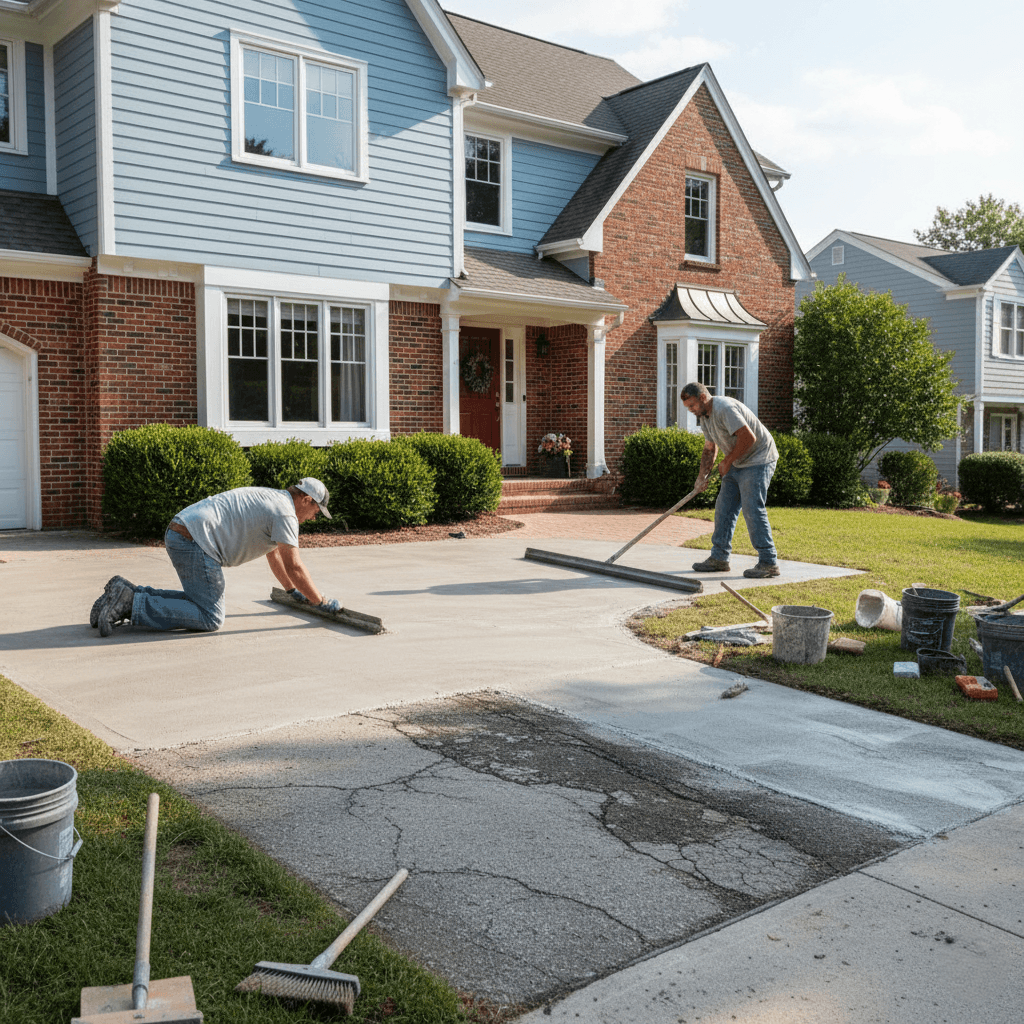
Full replacement typically costs two to three times more than resurfacing. You can expect to pay approximately $1.00 per square foot for the tear-out and removal of your existing driveway. Resurfacing costs range from $3 to $10 per square foot. Resurfacing addresses cosmetic issues like minor cracks, surface wear, and discoloration without requiring complete removal and reconstruction. Full replacement becomes necessary when the driveway exhibits significant structural damage.
What slope gradient should Somerville driveways and patios incorporate for effective water management?
A slope gradient of 1/8 inch to 1/4 inch per foot facilitates water drainage away from structures. Proper grading proves critical in Somerville to prevent standing water accumulation, which accelerates surface deterioration, encourages algae colonization, and creates safety hazards. Inadequate drainage substantially reduces surface lifespan through repeated water infiltration and destructive freeze-thaw cycles.
Are building permits required for concrete driveway and patio installations in Somerville?
Anyone seeking to construct, reconstruct, alter, repair, or demolish a structure or install a sign must first obtain a building permit from the Inspectional Services Division (ISD). Per the Somerville Zoning Ordinance and the Massachusetts State Building Code (780 C.M.R.), a building permit must be obtained before the start of any work and must be prominently displayed at the job site. Most concrete work in Somerville requires a building permit.
What specifications does the Massachusetts Building Code establish for concrete installations?
Nonstructural concrete must have a minimum specified compressive strength of 2,500 psi for Class F0; 3,000 psi for Class F1; and 3,500 psi for Classes F2 and F3. Massachusetts regulations align with national standards for concrete specifications, strength ratings, and reinforcement protocols. Consult with licensed contractors familiar with the Massachusetts Building Code for compliance guidance specific to your project scope.
What inquiries should homeowners direct toward concrete contractors before finalizing hiring agreements?
Ask about the current state of contractor licensing, proof of adequate insurance protection, references from recent Somerville-area projects, comprehensive project timeline estimates, post-installation cleanup plans, warranty specifics and coverage limitations, joint placement and slope management strategies, and demonstrated understanding of Massachusetts climate demands, including freeze-thaw protection. Transparent contractor communication prevents misunderstandings and facilitates superior outcomes.
Must building permits be secured before concrete work commences in Somerville?
Yes, the building permit must be obtained before the start of any work and prominently displayed at the job site. Commencing work without obtaining required permits can result in significant fines, forced project halts, and mandatory remediation. Always verify permit requirements with municipal authorities and secure authorization before breaking ground on any concrete project.
Are small hairline cracks normal in concrete installations, or do they indicate structural concerns?
Hairline cracks resulting from natural concrete shrinkage are generally acceptable and do not indicate structural defects. Wide cracks that expand progressively may signal settlement, foundation stress, or freeze-thaw damage requiring professional evaluation. In Somerville’s climate, cracks should receive prompt sealing to prevent water infiltration and ice formation that accelerates deterioration.
Will winter de-icing chemicals harm concrete in Somerville, and which ice melt alternatives are recommended?
Chloride-based de-icing salts cause surface scaling, spalling, and structural deterioration when applied repeatedly. When Somerville experiences winter conditions, calcium chloride or salt-free ice melt products offer safer alternatives. Pre-season protective sealing provides insurance against road salt and repeated freeze-thaw damage. Professional snow removal services reduce reliance on chemical treatments that compromise concrete durability.
What weather conditions prove optimal for scheduling concrete installation activities in Somerville?
Spring through early autumn generally presents favorable conditions for pouring concrete in Somerville. Temperatures between 50-85 degrees Fahrenheit provide ideal conditions. Avoid scheduling pours when nighttime temperatures approach freezing, as concrete requires warmth to cure properly. Somerville’s unpredictable weather patterns may necessitate flexibility and contingency planning. Professional contractors monitor forecasts and schedule work strategically.
What distinguishes sealed concrete from unsealed concrete, and does protective sealing truly prevent environmental damage in Somerville?
Sealed concrete resists staining, moisture infiltration, and freeze-thaw damage. Unsealed installations demonstrate vulnerability to cracking, deterioration, surface discoloration, and efflorescence development. In Somerville’s challenging climate with repeated freeze-thaw cycles and road salt applications, sealing represents an essential investment in surface longevity. Regular resealing every two to three years maintains protection effectiveness.
What factors influence the total cost per cubic yard when ordering ready-mix concrete for Somerville projects?
Concrete can cost $75 per cubic yard. Several factors impact concrete pricing. Short-load premiums apply to orders under minimum quantities. Equipment rental for pump truck access occurs when site conditions are constrained. Transportation costs vary based on distance from supplier facilities. Specialty chemical additives for freeze-thaw protection increase material costs. Winter weather conditions may also affect pricing and availability.
What price range should be expected for stamped concrete alternatives compared to standard broom-finished installations?
Stamped concrete typically adds $3-$8 per square foot over plain broom-finished surfaces. Simple decorative enhancements, such as color accents or borders, add $2-$5 per square foot. Premium decorative finishes combining multiple techniques and artistic elements can exceed standard pricing considerably. Weigh aesthetic improvements against budget constraints.
What thickness should residential driveway concrete slabs be in Somerville?
Standard residential driveways in Somerville typically utilize a 4-inch thickness as a baseline specification. For properties anticipating heavier vehicle usage, recreational vehicle storage, or commercial vehicle traffic, a 5-6 inch thickness provides enhanced durability. Thicker sections reduce cracking probability and extend service intervals, proving especially valuable in Somerville’s freeze-thaw environment.
Can concrete surfaces be economically installed as overlays on existing degraded concrete bases in Somerville?
Overlay installations function effectively over existing concrete foundations provided base surfaces demonstrate structural soundness, thorough cleanliness, and absence of major structural compromise. Thin overlay applications deliver attractive cosmetic revitalization, though substantial structural repairs demand complete removal and new installation. Somerville’s moisture conditions and freeze-thaw environment necessitate meticulous base preparation and moisture management.